Key Ayurvedic Principles
- Nadi Pariksha assesses arterial wave velocity, amplitude, rhythm, and depth across Vata, Pitta, and Kapha.
- Can detect metabolic toxins (Ama) and subclinical organ stress months before standard biochemical tests.
- Must be performed on an empty stomach during early morning hours for optimal diagnostic precision.
- Forms the foundational diagnostic basis for all Panchakarma protocols at Atharva Ayurved in Indore.
The Radial Artery as a High-Fidelity Waveform Sensor
To the untrained observer, taking a pulse looks like simply counting heartbeats per minute. However, the radial pulse is a composite waveform carrying hydrodynamic shockwaves generated by cardiac ventricular contraction bouncing off the arterial tree, modulated by autonomic nervous tone, blood viscosity, and tissue resistance.
In classical Ayurvedic texts like the Sarngadhara Samhita and Yogaratnakara, Nadi Pariksha is described as the primary window into the status of the three Doshas (Vata, Pitta, Kapha), the seven Dhatus (bodily tissues), and Manas (psycho-emotional state).
“Just as the strings of a veena express all musical melodies, the pulse at the root of the thumb reveals all systemic diseases.” — Yogaratnakara
The Three-Finger Sensor Architecture
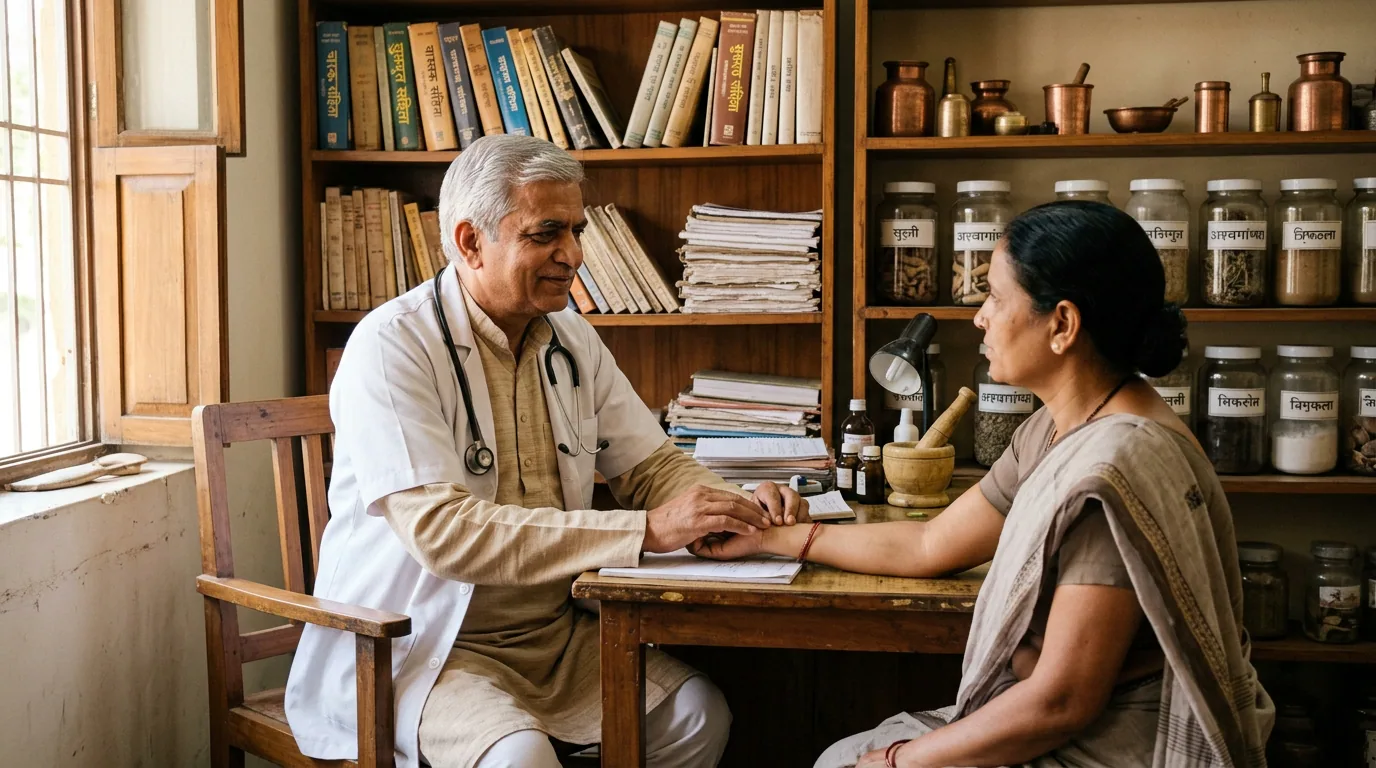
A master Vaidya places three fingers along the radial artery beneath the styloid process: the index finger (Vata), middle finger (Pitta), and ring finger (Kapha).
Each finger assesses specific physiological characteristics: movement like a serpent (Sarpa Gati for Vata), bounding like a frog (Mandooka Gati for Pitta), or graceful like a swan (Hamsa Gati for Kapha). Variations in depth reveal deep chronic tissue toxicity versus acute functional fluctuations.
Clinical Applications in Modern Preventive Health
At Atharva Ayurved in Indore, Dr. S.N. Patidar uses Nadi Pariksha to detect subclinical fatty liver progression, insulin insensitivity, digestive fire weakness, and occult autoimmune activity before irreversible structural changes manifest.
This allows proactive, personalized Panchakarma and herbal prescription tailored exactly to the patient’s constitutional bio-identity.
Dr. S.N. Patidar
Chief VaidyaBAMS, DAFE, MSc Yoga · Chief Vaidya & Clinical Director
Dr. S.N. Patidar leads Atharva Ayurved in Nipania, Indore, specializing in pulse diagnostics (Nadi Pariksha), non-surgical spine rehabilitation, autoimmune condition reversal, and classical Panchakarma therapies.